

In modern manufacturing, efficiency is the currency of success. Companies that produce heavy machinery, aerospace components, defense systems, or energy equipment know that time is just as valuable as material. Every hour saved in the supply chain translates to faster production, quicker project completion, and reduced costs. One of the most effective ways distributors support this need for efficiency is through custom cutting services performed at the distribution center.
Rather than shipping oversized bars to a customer who must then cut them down in-house, distributors with advanced cutting capabilities deliver material in the exact dimensions required. This approach saves time, reduces waste, and streamlines the flow of operations. In this blog, we explore how custom cutting at distribution centers creates value, how the process works, and why it has become an essential part of large-diameter bar distribution.
Why cutting matters in large-diameter bar distribution
Large-diameter round bars often arrive from mills in long lengths, sometimes exceeding 20 or 30 feet. While mills produce and ship these long bars for logistical efficiency, manufacturers rarely need entire lengths for a single component. Instead, they require precise cut pieces tailored to their projects.
Cutting large bars is no small task. These materials can weigh thousands of pounds and require specialized saws, handling equipment, and trained operators. By the time a manufacturer sets up equipment, moves material, performs cuts, and re-certifies each piece, hours or even days can be lost. Distribution centers that offer cutting services eliminate this bottleneck by shipping pre-cut, ready-to-machine pieces.
The advantages of custom cutting at the distribution stage
- Reduced production lead times
When bars arrive already cut to size, manufacturers can move directly to machining. This eliminates time spent setting up saws, allocating manpower, and performing repetitive cuts. Projects move forward faster because the material is immediately usable.
- Lower labor and equipment costs
Cutting oversized bars in-house requires heavy-duty band saws, blades capable of handling large cross sections, and maintenance to keep machines in working condition. It also requires skilled operators and floor space. By outsourcing this step to the distributor, manufacturers save on both capital and labor expenses.
- Precision and consistency
Distribution centers that specialize in custom cutting use advanced saws and precision equipment designed for large-diameter stock. These machines provide accurate cuts with tight tolerances and clean finishes. Consistency in cutting improves efficiency downstream because machinists spend less time squaring or cleaning up parts.
- Material optimization
Distributors often use nesting software to plan cuts efficiently. By calculating the best way to divide a long bar into multiple pieces, they reduce waste and maximize usable material. This optimization translates into cost savings for customers.
- Maintained certification and traceability
A critical benefit of cutting at the distribution level is that certification is preserved. Each cut piece is tagged and traced back to its original heat number and mill test report. This ensures that even smaller pieces maintain compliance with industry standards.
- Improved safety
Handling and cutting large-diameter bars in-house introduces risk. Heavy lifting, saw operation, and chip removal create potential safety hazards. Letting the distributor manage this step reduces exposure and keeps manufacturing environments safer.
The process of custom cutting at distribution centers
Distributors invest heavily in equipment and processes to perform accurate and efficient cutting services. The workflow typically includes:
- Material selection and verification
Bars are pulled from inventory, verified against order specifications, and checked for straightness and surface condition. - Programming and planning
Operators input dimensions into cutting machines. Advanced saws use digital controls or CNC systems to ensure accuracy. Nesting software may be used to minimize waste. - Precision sawing
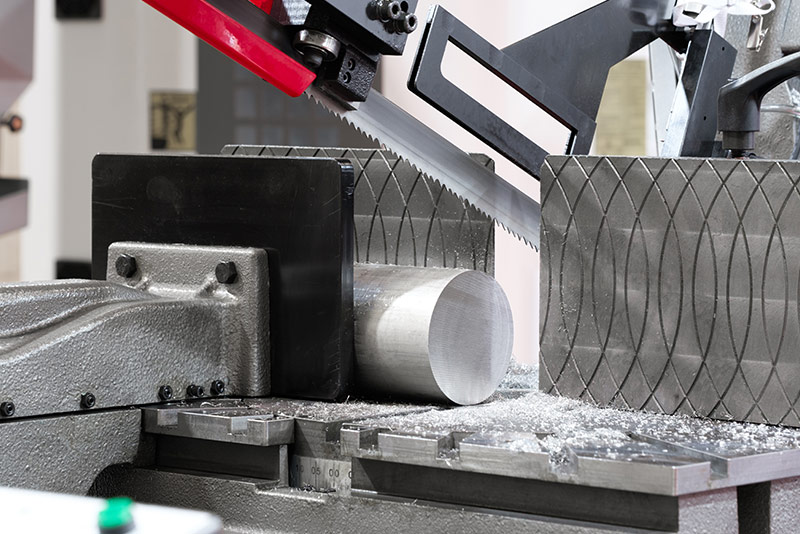
Heavy-duty horizontal or vertical band saws perform cuts, often capable of handling bars up to 32 inches in diameter. Some saws feature automatic feeds and coolant systems to improve accuracy and extend blade life. - Tolerances and inspection
Cut pieces are measured against specified tolerances, often within ± 0.125 inches or tighter depending on customer needs. - Marking and traceability
Each piece is labeled with heat numbers, lot information, and certification data to ensure traceability is preserved. - Packaging and shipping
Cut parts are securely packaged for transport, with care taken to avoid surface damage or distortion during shipping.
Applications that benefit from pre-cut materials
Custom cutting services add value across industries where large-diameter round bars are essential.
- Aerospace: Landing gear struts, actuator housings, and turbine shafts require precise lengths of alloy and stainless bars. Receiving pre-cut material accelerates machining schedules.
- Defense: Naval shafts, weapon components, and armored vehicle parts rely on large-diameter stock. Pre-cut bars ensure traceability while reducing in-house workload.
- Energy: Turbine rotors, generator shafts, and pressure vessel components benefit from accurate cuts that allow machining to start immediately.
- Heavy equipment: Excavators, cranes, and mining machinery require strong, oversized shafts and pins. Cutting at distribution centers helps manufacturers scale production without delays.
- Oil and gas: Drill collars, pump shafts, and offshore platform components demand corrosion-resistant alloys that are often difficult to cut in-house. Distributors provide the expertise and equipment needed.
How cutting services improve supply chain efficiency
Custom cutting at distribution centers is more than a convenience. It is a supply chain strategy. By moving the cutting process upstream, manufacturers streamline their own operations and reduce unnecessary steps. This approach creates:
- Shorter cycle times from raw material arrival to finished part.
- Lean inventory because manufacturers no longer need to stock full-length bars or keep excess cutoffs on-site.
- Lower total cost of ownership since distributors spread equipment, labor, and maintenance costs across multiple customers.
- More predictable scheduling because material arrives in ready-to-use form, reducing uncertainty in production planning.
Best practices for leveraging cutting services
Manufacturers who want to maximize the benefits of custom cutting should consider the following practices:
- Provide detailed specifications: Clear length requirements, tolerances, and finish needs ensure the distributor delivers exactly what is required.
- Plan orders in advance: Communicate project timelines so distributors can schedule cuts efficiently and align inventory.
- Use stocking programs with cutting services: Some distributors reserve both material and cutting capacity for loyal customers, ensuring availability even during high demand.
- Coordinate packaging preferences: Request bundling, palletizing, or protective wraps as needed to simplify handling upon arrival.
- Evaluate cost savings holistically: Consider not just the price of cutting services but also the time, labor, and equipment costs saved in-house.
Looking ahead
As manufacturing grows more competitive, the pressure to save time without sacrificing quality continues to increase. Distributors that offer custom cutting services will remain critical partners for companies that depend on large-diameter bars. Emerging technologies, such as automated sawing systems and digital order tracking, will only enhance the precision and efficiency of these services.
Manufacturers who embrace distributor-based cutting will gain a competitive advantage by freeing internal resources, reducing waste, and ensuring that materials flow seamlessly into production.
Custom cutting at distribution centers is a practical solution that saves time, reduces costs, and streamlines supply chains. Instead of managing the challenges of cutting massive bars in-house, manufacturers can rely on distributors to deliver precise, ready-to-use pieces with full certification and traceability.
In industries where large-diameter bars form the backbone of critical components, speed and accuracy matter. By partnering with distributors that provide cutting services, manufacturers reduce lead times, improve safety, and gain the flexibility needed to keep projects on schedule. The result is a more efficient supply chain, stronger competitiveness, and materials that arrive ready to perform from the moment they hit the shop floor.

